Gold EA drawdown: how much is too much?
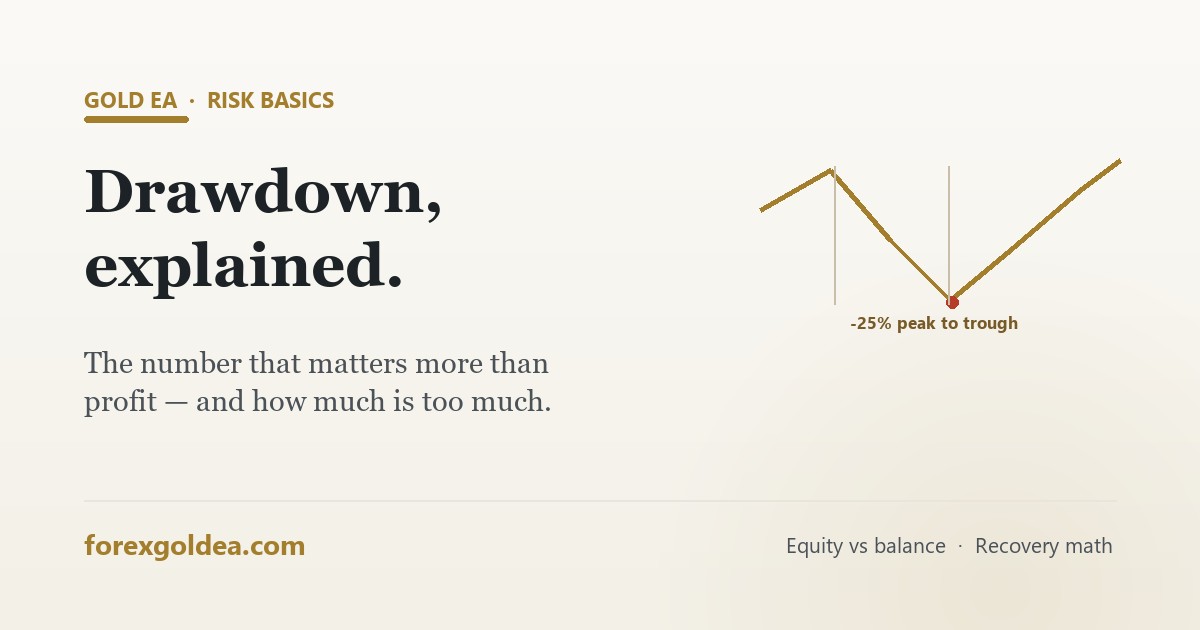
Every EA advertisement leads with profit. The number that actually decides whether you survive is the one in the fine print: drawdown. Here's what it means, why it beats profit as a metric, and how much is too much for an automated gold strategy.
The valley, and what it costs to sit in it
Your account grows from $1,000 to $1,200, a losing streak drags it to $900, then it recovers. That valley — $300, or 25% from the peak — is a drawdown. The maximum drawdown is the deepest valley in the whole history of the account or backtest.
It answers the only question that matters on a bad month: "how much pain would I have had to sit through — and would I have kept the robot running?" Most people honestly wouldn't. Deep-drawdown systems fail in real hands not because the maths never recovers, but because the human switches the EA off at the bottom of the valley.
The number the advert never leads with
Two gold EAs both show +60% a year. Same profit — completely different products:
| EA "A" | EA "B" | |
|---|---|---|
| Annual return | +60% | +60% |
| Max equity drawdown | 12% | 55% |
| What that means | Steady edge, survivable streaks | Repeatedly one bad week from ruin |
Marketing shows you the +60%. The drawdown row is where the truth lives — the same honesty test we applied in are gold EAs actually profitable?
Why a loss costs more than it looks
Whatever percentage you lose, you need a bigger percentage gain to get back:
| Drawdown | Gain needed to recover |
|---|---|
| 10% | +11% |
| 25% | +33% |
| 50% | +100% |
| 75% | +300% |
This is why "avoid deep drawdowns" isn't cautious advice — it's maths. A system that halves the account must double just to reach zero progress. And it's why risk per trade is the setting that matters most: small fixed risk keeps a normal losing streak inside the survivable zone.
The smooth-curve illusion
This distinction catches almost every beginner:
- Balance drawdown counts only closed trades.
- Equity drawdown also counts floating losses on open positions.
So what number should you actually accept?
| Max equity drawdown | Honest read |
|---|---|
| Under 10–15% | Conservative — typical of fixed-risk, hard-stop systems |
| 15–30% | Moderate — fine if returns justify it and you can stomach it |
| 30–50% | Aggressive — most people abandon the robot mid-valley |
| 50%+ | Red flag — needs +100% just to break even |
Two personal filters beat any table. One: could you watch real money fall that far without pulling the plug? Two: is the account funded so a normal streak stays survivable? That second question is exactly what how much money a gold EA needs answers.
Checking it yourself, before money is involved
- Backtest it honestly. Read "maximal equity drawdown" on a long, realistic test — and treat that as the minimum you'll meet live. Method: how to backtest a gold EA.
- Demo it through news weeks. Watch whether live-condition drawdown matches the backtest's pattern — the matching test from our demo-to-live guide.
- Check the logic. Hard stop-loss + fixed small risk per trade = bounded, honest drawdown. "Recovery" logic with no stops = deferred risk, not low risk.
- Fund for the worst streak, not the average month — assume the deepest valley arrives the week after you go live.
Where ForexGoldEA stands
ForexGoldEA puts a fixed stop-loss on every trade and uses no martingale, so its drawdown shows up honestly in the equity curve instead of hiding in open positions. That doesn't make drawdown zero — no real strategy has zero — it makes it visible, bounded and survivable. Judge it exactly the way this guide describes: backtest, demo through a news week, then start small.
Reader questions
What does drawdown mean on a trading account?
The fall from an account's peak to its lowest point before a new peak — e.g. $1,200 → $900 is a 25% drawdown. Max drawdown is the worst ever recorded.
At what drawdown should I switch a gold EA off?
Under 10–15% conservative, 15–30% moderate, 50%+ a red flag — at 50% you need +100% just to break even.
What is the difference between balance and equity drawdown?
Balance counts closed trades only; equity includes floating losses. Equity is the honest number — grid/martingale systems hide risk in open trades.
Why does drawdown matter more than profit?
Recovery is asymmetric (25% down needs +33%, 50% needs +100%), so identical profits can hide completely different risks of ruin.
Does a stop-loss limit drawdown?
It caps each trade's loss, keeping drawdown bounded and visible — especially with 1–2% fixed risk per trade.
What is ForexGoldEA's approach?
Fixed stop-loss on every trade, no martingale — drawdown stays honest in the equity curve. Verify it yourself via backtest and demo before going live.
Where this leaves you
Profit is the number strategies advertise; drawdown is the number they survive — or don't. Read maximum equity drawdown, respect the recovery math, size the account for the worst streak, and only trust systems whose losses are capped by design. Get drawdown right and most bad gold EAs filter themselves out before they cost you anything.
Affiliate disclosure: we earn a commission when you open and fund an account through our partner links, at no extra cost to you.