Gold or silver: the same story, told at different volumes
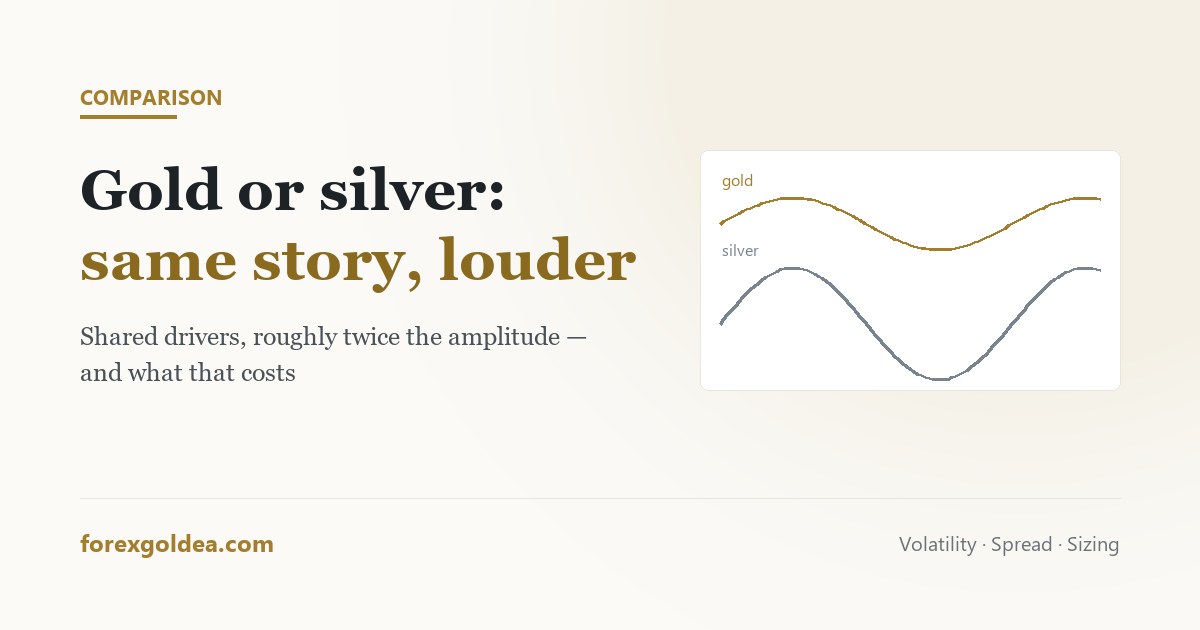
Silver is often described as gold's cheaper cousin, which is true about the price and misleading about everything else. The two respond to the same macro forces, but silver responds harder, from a thinner order book, with an industrial demand story that gold does not carry. For a trader that combination changes almost every practical decision.
In short both metals respond to the same drivers — real interest rates, the dollar, inflation expectations, safe-haven demand — so they usually move in the same direction. Silver moves substantially further in both directions because its market is smaller and roughly half its demand is industrial, which ties it to manufacturing cycles gold ignores. Practically: silver's percentage swings are wider and its spread is usually wider relative to the move, so the same account risk requires a meaningfully smaller position. For a newer or smaller account, gold is the more forgiving instrument.
The same drivers, a louder reaction
Start with what they share, because it is most of the story. Both are priced in dollars, both yield nothing, and both are bought when the real return on holding cash and bonds falls. A rate expectation shifting or the dollar weakening moves both metals, usually on the same day and in the same direction.
What differs is amplitude. Silver's market is far smaller than gold's, so the same flow of money produces a larger percentage move. Traders describe this as silver being “high beta” to gold: when gold rallies, silver tends to rally more, and when gold sells off, silver falls further.
This is why silver looks attractive in a rising market and why it removes accounts in a falling one. The property that produces the bigger winner is the identical property that produces the bigger loser.
The industrial half
The genuine structural difference is demand. Gold's demand is dominated by investment, jewellery and central bank buying. A substantial share of silver's demand is industrial — electronics, solar panels, medical and electrical applications.
That gives silver a second driver gold does not have: manufacturing activity. Silver can therefore weaken on a weak growth outlook even while gold strengthens on the same news, because the safe-haven bid supporting gold is offset by an industrial demand worry that gold has no exposure to.
The practical implication is that silver is harder to reason about. A gold trader watching real yields and the dollar has most of the picture. A silver trader needs that plus a view on industrial demand, and those two can point in opposite directions at the same time.
What that means at the order window
| Gold (XAU/USD) | Silver (XAG/USD) | |
|---|---|---|
| Main drivers | Real yields, dollar, safe-haven demand, central banks | The same, plus industrial demand |
| Typical daily range | Wide in absolute dollars | Wider in percentage terms |
| Market depth | Deeper | Thinner — moves extend further |
| Spread | Wider than major currency pairs | Usually wider again relative to the move |
| Behaviour in risk-off events | Frequently bid as a haven | Mixed — haven bid competes with growth worries |
| Suits | Most traders, including newer accounts | Experienced traders sizing deliberately smaller |
Two numbers deserve attention before trading either. The first is the contract specification: brokers define metal contract sizes differently, so a “standard lot” of silver is not comparable to one of gold, and assuming otherwise is a fast way to open a position several times larger than intended. Check it in the symbol specification, and confirm the arithmetic with a lot size calculation.
The second is the spread relative to the move you expect to capture. Silver's spread frequently consumes a larger share of a short-term trade than gold's does, which makes fast in-and-out approaches harder to justify — the same cost logic set out in what the spread really costs you.
The gold-silver ratio, honestly
The ratio — how many ounces of silver buy one ounce of gold — is widely quoted, and it does describe something real about the relationship between the two metals over long periods.
As a trading signal it is far weaker than its popularity suggests. The ratio can remain historically stretched for years, and “it has to revert” is not a plan with a defined invalidation point or a timeframe. Traders who commit to a reversion on that basis usually find the position outlives their patience.
Treated as background context about which metal has been favoured, the ratio is useful. Treated as a mean-reversion trade for a retail account, it asks for a holding period and a tolerance for drawdown that most accounts do not have.
Which one to start with
For a smaller or newer account, gold is the more forgiving instrument — not because it is safe, but because its behaviour is explicable with fewer moving parts and its moves, while large, are less prone to the sharp extensions a thinner market produces.
Silver is a legitimate instrument for someone who understands both drivers and, crucially, sizes for the extra volatility rather than treating it as gold at a lower price. The most common silver mistake is precisely that substitution: taking the position size that felt right on gold and applying it to something that moves considerably further.
If you do trade both, treat them as correlated rather than independent. Long gold and long silver is not diversification; it is one macro position expressed twice, and it will draw down together on the day that view is wrong.
Reader questions
Is silver more volatile than gold?
Yes. Silver's smaller market produces larger percentage moves both ways, so the same risk needs a smaller position.
Do gold and silver move together?
Usually yes, since they share macro drivers. They diverge when industrial demand moves silver and leaves gold unaffected.
Which is better for beginners, gold or silver?
Gold. Fewer drivers to understand and a deeper market, which makes its behaviour easier to reason about.
What is the gold-silver ratio and is it useful?
It shows how many silver ounces buy one gold ounce. Useful as context, weak as a signal — it can stay stretched for years.
Is trading silver more expensive than gold?
Relative to the move captured, usually yes — silver's spread is proportionally wider. Check contract sizes, which differ by broker.
Can I trade gold and silver at the same time?
Yes, but they are correlated — long both is one macro bet expressed twice. Size the pair as a single position.
Where this leaves you
Silver is not gold with a smaller price tag. It is the same macro story amplified by a thinner market and complicated by an industrial demand cycle gold does not carry — which makes it a legitimate instrument for a trader who sizes for that difference, and an expensive lesson for one who does not. If you are still learning how the metals behave, gold asks you to understand fewer things at once, and that is worth more than a larger daily range.
Affiliate disclosure: we earn a commission when you open and fund an account through our partner links, at no extra cost to you.