Reading an economic calendar without drowning in it
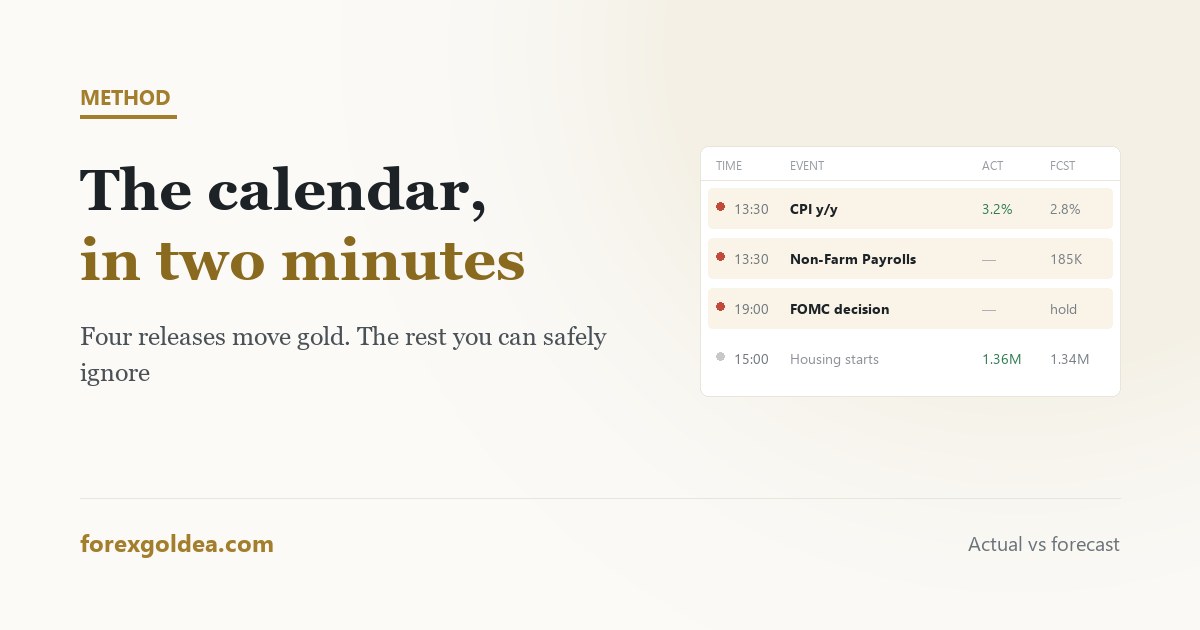
An economic calendar looks like a wall of numbers and most of it genuinely does not matter to you. Four releases move gold reliably; the rest is background. Learning which four, and learning that the number itself matters far less than how it compares to what was expected, turns the calendar from intimidating into a two-minute weekly habit.
In short the columns are time, currency, impact, actual, forecast and previous. The one that matters is the gap between actual and forecast — markets price in the forecast beforehand, so a result that matches it often produces no move at all while a surprise moves everything. For gold, filter to USD, high impact and you are left with four things worth knowing: FOMC decisions, CPI inflation, Non-Farm Payrolls, and Fed speeches. Most traders use the calendar to know when to stand aside, not when to trade.
What the columns mean
Every calendar shows the same six things, whatever the site.
| Column | What it is |
|---|---|
| Time | Release time. Check the timezone setting first — most default to something that is not yours. |
| Currency | Which economy the data is about. For gold, USD is what matters. |
| Impact | Expected market reaction, usually colour-coded. Filter to high and ignore the rest. |
| Actual | The number, published at release time. Blank until then. |
| Forecast | What economists expected. This is already priced in. |
| Previous | Last period's figure, for context. |
Set the timezone before anything else. A calendar showing New York time when you trade from elsewhere produces the specific mistake of being in a position at exactly the moment you meant to be flat.
The forecast matters more than the number
This is the part that trips up almost everyone reading a calendar for the first time.
Markets do not react to whether inflation was high. They react to whether it was higher than expected. The forecast is already reflected in the price before the release, because participants have positioned for it. A number that lands exactly on forecast frequently produces almost no movement, however dramatic the figure sounds.
This is why watching the actual number alone tells you nothing about which way price will go. It also explains the common experience of seeing terrible economic news and watching the market rise: the news was expected, and something else in the release was not.
The four that actually move gold
Filter to USD and high impact and the list shrinks to something manageable. For XAU/USD, these are the ones worth knowing about.
- FOMC rate decision and statement. The largest single mover. Gold yields nothing, so the return available on cash and bonds is the central input to holding it — the relationship set out in what moves the gold price.
- CPI inflation. Feeds directly into rate expectations, which feeds into gold. Frequently the second-biggest move of the month.
- Non-Farm Payrolls. First Friday of the month, US employment. Moves gold through the same rate-expectation channel, and produces some of the widest spreads of the month.
- Fed speeches and minutes. Less predictable than the scheduled data because the reaction depends on tone rather than a number, which makes them harder to prepare for.
Everything else — regional surveys, secondary employment measures, most non-US data — can be ignored for gold purposes without missing much.
Using it defensively, which is the honest use
The calendar is usually presented as a way to find opportunities. For most retail traders its real value is the opposite: knowing when to be flat.
In the minutes around a high-impact release, three things happen at once. Spreads widen, often several times normal on gold. Slippage increases sharply, so orders fill at prices well away from where they were requested. And price can move in both directions before settling, taking out stops on either side.
The result is that even a correct directional call can lose money, because the entry filled badly and the stop was reached during the initial whipsaw. This is why most consistent approaches simply stand aside — covered in more depth in trading gold during news.
A two-minute weekly routine
- Sunday or Monday: open the calendar, set the timezone, filter to USD and high impact.
- Note the two or three events for the week and write the times somewhere you will see them.
- Plan around them: decide in advance whether you will be flat, and if you hold positions through, size them for a wider-than-normal move.
- After the release, compare actual against forecast rather than against previous. That gap explains the reaction.
- Wait for spreads to normalise before trading again. Fifteen to thirty minutes is usually enough on gold.
That is the whole discipline. It costs a couple of minutes a week and prevents a category of loss that has nothing to do with whether your analysis was any good.
Reader questions
What do actual, forecast and previous mean on an economic calendar?
Actual is the published figure, forecast is what was expected, previous is last period. The reaction comes from actual minus forecast.
Which economic news affects gold the most?
FOMC decisions, CPI inflation, Non-Farm Payrolls and Fed speeches — all working through rate expectations.
Why did gold not move even though the news was bad?
Because it matched the forecast, which was already priced in. Moves come from the surprise, not the number.
Should I trade during high-impact news?
Usually not. Spreads widen, slippage spikes and price whipsaws, so even a correct call can lose money.
How long should I wait after a news release before trading?
Usually 15 to 30 minutes on gold. Watch the spread in Market Watch rather than the clock.
Which economic calendar should I use?
Any established one — they show the same data. What matters is setting your timezone and filtering to USD high impact.
Where this leaves you
An economic calendar is mostly noise with four useful entries. Filter to US high-impact data, read the gap between actual and forecast rather than the number, and use the result to decide when to be flat rather than when to trade. Two minutes at the start of the week is enough — and it removes a category of loss that has nothing to do with whether your read on the market was right.
Affiliate disclosure: we earn a commission when you open and fund an account through our partner links, at no extra cost to you.